Agentic AI for
building operations.
Scale engineering capacity and grow NOI with always-on AI that finds and fixes problems, 24/7 across every asset.
Trusted by global owners and operators across 300M sq ft:


An always-on AI operating system for your portfolio.
Agentic AI that knows your buildings like your best engineer.
I checked CH-2's open Insights and its runtime over the last 24 hours.
It started 16 times yesterday, running 15–25 minutes at a time.
Root cause
CH-2's staging logic switches it fully on and off instead of letting it unload. With a 1.0°F restart deadband and no minimum run or off time, it meets setpoint in minutes at light loads, shuts off, then restarts.
Built for the teams who run buildings. Whether you're managing a portfolio or executing work on the ground, Noda fits into your day and lightens your load.


See what your portfolio
is leaving on the table.
Energy savings
15–25%
Average annual reduction across deployed assets.
Maintenance savings
5–15%
Lower reactive repair and equipment replacement costs.
Data points processed daily
100M+
Across BMS, IoT, weather, and utility signals.
Year 1 ROI
250–350%
Customer average, attributable to operational improvements.
Proof in the Projects.
$166,000 in annual savings by rerouting tenant loads off a 24/7 chiller plant.
What Noda DiagnosedA landmark DC office tower ran two chillers 24/7 to serve tenant supplemental loads, even though overnight activity was minimal. Migrating those tenant systems to the retail condenser loop let the main chiller shut down 9 PM–6 AM, cutting ~20,000 kWh weekly year-round.
We found Noda to be highly experienced in providing us a truly unified platform that brings all our systems together to achieve a single harmonious output. Together, we’re improving building performance and standardizing operations.
- Portfolio
- 36 retail centers
- GLA
- ~37.5M sq ft
- 2030 Goal
- Carbon neutral operations



Secure. Scalable. No rip‑and‑replace.
Noda gateways at each site connect to the building management systems, meters and sensors already in place.
- ISO 27001 certified
- Outbound-only connection keeps the building network closed to inbound traffic
- Approved by enterprise IT and security teams
Insights
View All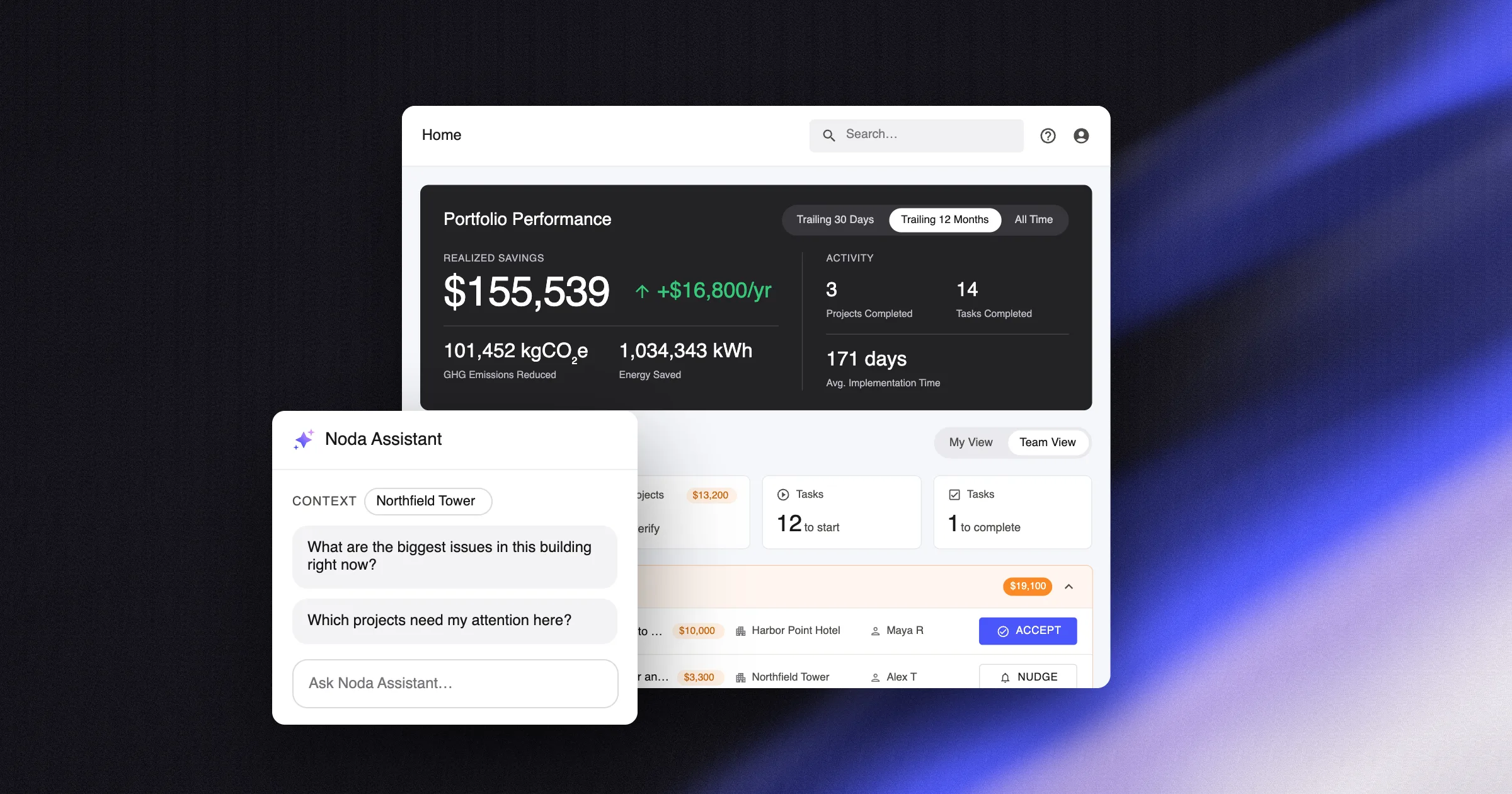


Frequently
Asked
Questions
How does Noda use agentic AI in commercial buildings?
Noda is agentic AI for commercial building operations: a virtual building engineer that works across an entire portfolio. Noda analyzes BMS trend data, meter data and weather around the clock to detect faults. Noda's AI agents then trace faults to their root causes and package the causes worth fixing as Projects, each carrying its estimated savings. Engineers review those Projects and decide which changes to make. In practice, an engineering team's hours go to changes with known savings, while Noda's AI agents carry the round-the-clock monitoring and diagnosis that few teams could staff across every building.
How is agentic AI different from fault detection and diagnostics?
Fault detection and diagnostics (FDD) software stops at the fault list, while agentic AI carries on through diagnosis to a recommended change. A Lawrence Berkeley National Laboratory study of 317 buildings counted an average of 245 faults per building each month, and FDD leaves each of those faults for a person to investigate. Across a portfolio, that volume is far more than an engineering team can reasonably triage, so many faults go unresolved and the energy waste behind them keeps running. Noda groups related faults by their common root cause, estimates what fixing each cause would save, and delivers each cause as a Project ready for an engineer to accept. Handing engineers scoped work that is ready to execute means more savings get realized, faster.
How do agentic AI systems reduce operating costs in commercial buildings?
Agentic AI reduces operating costs by finding operational waste that engineering teams rarely have the hours to diagnose: setpoints, schedules and control sequences that have drifted from what a building needs. Correcting that drift costs little or nothing, because each fix is a change to the controls. Left undiagnosed, the same waste shows up on every utility bill, and each month a fix waits is a month of savings a building never recovers. At one South Florida oceanfront resort, lowering the chilled water pump differential pressure setpoint and taking a third pump out of sequence cut 335,000 kWh a year.
Does Noda work with our existing BMS?
Yes. Noda works with building management systems including Tridium Niagara, Johnson Controls Metasys, Siemens Desigo and Honeywell EBI. Each site gets a Noda LaunchPad, a secure on-premises gateway that connects to the BMS and to equipment controllers and IoT sensors running BACnet/IP, Modbus or MQTT. Meters connect through a separate Noda gateway. Deployment does not require replacing or reprogramming a BMS. Noda can therefore start finding savings in buildings as they run today, with the control systems and operating teams already in place.
Can Noda share building data with our other software and AI tools?
Yes. Noda's GraphQL API makes equipment, points, trend history, Insights and Projects available to analytics and reporting software. Noda's MCP server connects AI assistants and agents that support the Model Context Protocol, giving each one scoped access to the same standardized building data that Noda's own AI agents use.
Can AI control HVAC equipment directly?
Noda acts on equipment automatically in one case: Automated Demand Management (ADM), which sheds or shifts site demand in response to a utility signal or an operational condition, on equipment configured and functionally tested for that purpose. Every other Project goes to a person to accept before anything changes in a building. Engineers stay in charge of how their buildings run, and ADM still captures demand savings during events that move faster than a person can respond.
Does agentic AI replace building engineers?
No. Noda adds engineering capacity to the teams already in place. Noda's AI agents run the analysis that comes before a decision, including root cause analysis and savings estimates, and engineers decide which Projects to accept and carry out the work. As a result, the same team can cover more buildings, with more of each engineer's week spent completing fixes that carry known savings.